8.10.26
We have released a new research report, Beyond the Hype: The CTO's Guide to AI Reality.
Working closely with engineering leaders across banking, utilities, and scaling tech companies gives us a useful vantage point on what teams are experiencing on the ground. This post covers the first of five themes we have pulled together on the operational realities shaping engineering leadership right now.
Why Your Competitors Aren’t as Far Ahead as You Think
According to research from the IBM Institute for Business Value, 64% of CEOs admit that Fear of Missing Out (FOMO) drives technology investments before they have a clear understanding of the underlying business value.
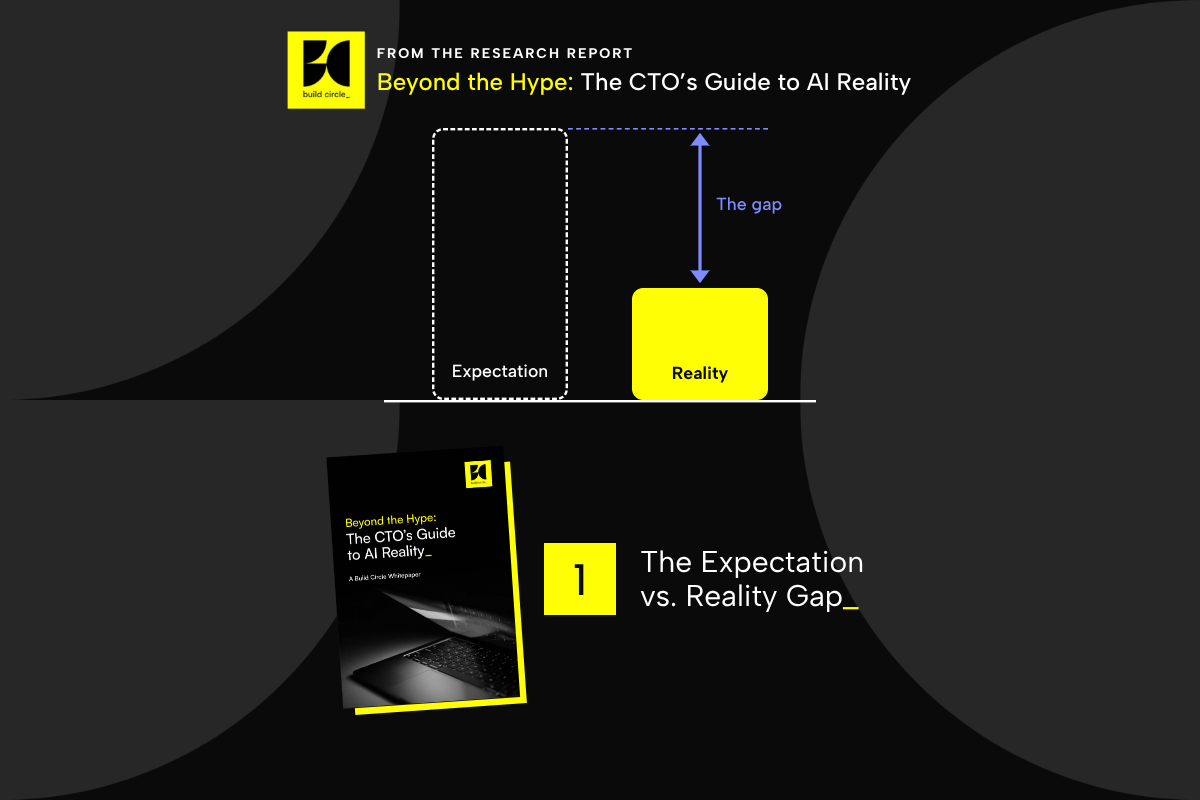
For Chief Technology Officers, this dynamic has created an environment of intense boardroom anxiety. Across our network, engineering leaders are fielding the same persistent question from executive boards: "What is everyone else really doing with AI?" The common assumption is that industry rivals have unlocked autonomous software factories, replaced entire delivery teams, and are shipping features at ten times their previous speed.
The cross-industry delivery data tells a different story.
Recent enterprise findings show that 75% of executives admit their current AI strategy is more for show than operational transformation, while BCG’s AI Value Gap study notes that 60% of companies generate no material value from AI. Furthermore, McKinsey reports that only 1% of organisations have achieved a truly mature AI operating model where autonomous agents integrate directly into production software pipelines.
The competitive gap is far smaller than it looks. Peer organisations are largely running pilot tests. Because late-movers do not need to invent foundation models from scratch, organisations with clean data and modernised cloud infrastructure can bridge this gap in months, bypassing the costly trial-and-error phases that tripped up early experimenters.
Upstream Bottlenecks: Velocity vs. Delivery Acceleration
Engineering teams routinely report 4x to 10x throughput increases in specific coding tasks. However, localised coding speed does not automatically translate into end-to-end delivery acceleration across the software delivery lifecycle (SDLC).
Instead, AI tooling has shifted operational bottlenecks upstream. When writing code syntax ceases to be the constraint, friction moves into requirements framing, edge-case definition, and data readiness. Gartner research reinforces this stating 67% of enterprise IT leaders cite process fragmentation and handoff failures as their primary delivery obstacles, far outweighing developer coding speed.
When 88% of organisations have introduced Generative AI into at least one function, yet fewer than 20% realise a systemic improvement in software delivery speed, the issue is the process, rather than the algorythm. Sustainable acceleration requires workforce readiness, cultural alignment, and end-to-end workflow redesign.
The CTO Action Plan
- Audit the Entire SDLC: Avoid treating AI as a blanket delivery accelerator. Audit your delivery lifecycle to identify where bottlenecks are shifting as developer coding speed increases.
- Differentiate Velocity from Throughput: Distinguish between rapid prototype creation and end-to-end release speed when reporting progress to the board.
- Establish Reality-Based Benchmarks: Anchor board metrics around verified operational baselines (such as a 20% release acceleration) rather than unverified 10x hype claims.
- Manage Peer Benchmark Paranoia: Ground capital allocation in internal architectural readiness and business outcomes rather than competitor adoption anxiety.
- Redesign Delivery Workflows: Organisations achieving measurable commercial return are nearly three times as likely to have redesigned their end-to-end workflows rather than simply layering AI tools onto existing tasks.
For verified benchmarks, architectural frameworks, and operating model blueprints, read Beyond the Hype: The CTO's Guide to AI Reality.


Contact us_
Whether you’re modernising, migrating, scaling, or strengthening resilience, we’ll help you deliver faster, safer, and with stronger teams.
Let's talk about your roadmap.


