11.11.26
We have released a new research report, Beyond the Hype: The CTO's Guide to AI Reality.
Working closely with engineering leaders across banking, utilities, and scaling tech companies gives us a useful vantage point on what teams are experiencing on the ground. This post covers the third of five themes we have pulled together on the operational realities shaping engineering leadership right now.
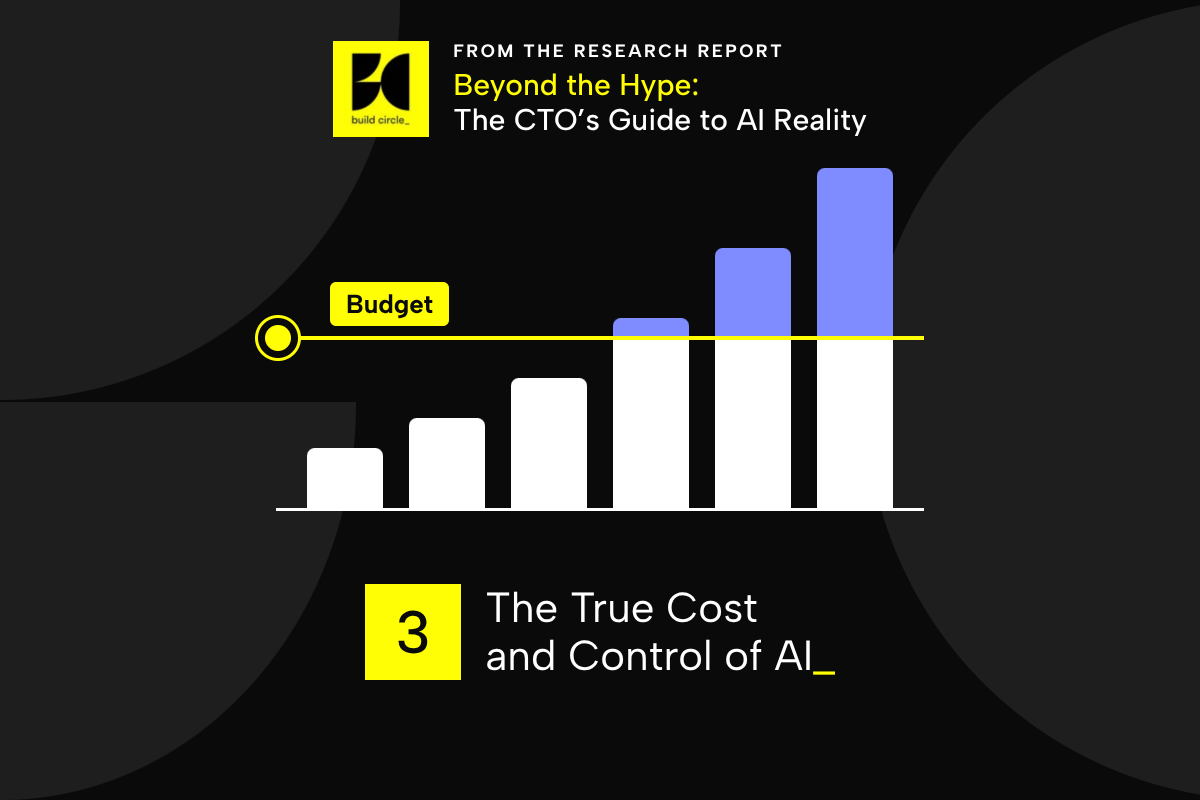
FinOps for LLMs: Architectural Patterns to Stop Token Cost Runaways
The era of limitless, unmonitored AI experimentation is over. As engineering departments transition from low-cost pilot testing to production-scale execution, the financial realities of inference and token consumption are escalating rapidly.
According to Gartner's cost research, at least 50% of Generative AI initiatives will exceed their planned budgets between now and 2028 due to poor architectural decisions and a lack of operational discipline.
While unit token pricing from foundation model providers is dropping due to chip efficiencies, the architectural shift toward agentic AI completely reverses those savings. Autonomous agentic workflows require 5 to 30 times more tokens per completed task than basic conversational queries. Because token consumption scales exponentially faster than unit prices decrease, Gartner projects inference to consume at least 70% of an AI model's lifetime operational costs.
Without structured token governance, annual AI coding expenses will surpass the average software developer's salary by 2028. CTOs cannot afford to manage AI as a discretionary expense; it requires strict engineering FinOps.
The Telemetry Blind Spot
Most technology leaders currently operate with a critical governance blind spot - over 70% of technology organisations lack central visibility into team-level AI usage, output quality, and enterprise data exposure.
While one senior engineer may use a sanctioned model to accelerate API test suites, another team may be using untracked consumer models or sending thousands of redundant context tokens through costly flagship LLMs. Without standardised telemetry and governing controls, leadership cannot distinguish productivity gains from unmonitored experimentation.
Why Claude and Open Protocols are Winning Enterprise Engineering
Cross-industry observations show a distinct shift toward Anthropic’s Claude models across technical organisations. Engineering teams are standardising on Claude due to its performance on software engineering benchmarks - leading evaluations like SWE-bench by autonomously resolving over 49% of real-world software issues - and its 200,000+ token context window for comprehending legacy codebases.
Beyond benchmark intelligence, engineering leaders cite open standards like Model Context Protocol (MCP) and non-training enterprise data guarantees. MCP allows teams to connect models cleanly into internal CI/CD pipelines, databases, and development environments without exposing proprietary logic or rebuilding bespoke middleware.
Pragmatic FinOps Interventions for Engineering Teams
- Context Engineering: Train developers to prune context prompts, eliminate redundant payload schemas, and use summarised inputs rather than blindly dumping entire code repositories into context windows.
- Task-Model Alignment: Map routine code refactoring and syntax tasks to smaller, cost-effective models. Escalate queries to premium flagship models only for complex architectural reasoning and security design.
- Model Harnessing: Avoid calling frontier models directly from raw application code with arbitrary context. Build architectural harnesses that enforce context hygiene and cache frequent prompt structures.
- Sprint Token Reviews: Mandate regular reviews of high-consumption API keys and developer workflows during sprint retrospectives to maintain budget discipline.
Read Chapter 3 of Beyond the Hype: The CTO's Guide to AI Reality for the complete FinOps governance framework.
Contact us_
Whether you’re modernising, migrating, scaling, or strengthening resilience, we’ll help you deliver faster, safer, and with stronger teams.
Let's talk about your roadmap.


