25.11.26
We have released a new research report, Beyond the Hype: The CTO's Guide to AI Reality.
Working closely with engineering leaders across banking, utilities, and scaling tech companies gives us a useful vantage point on what teams are experiencing on the ground. This post covers the last of five themes we have pulled together on the operational realities shaping engineering leadership right now.
Why Multi-Agent Systems Are Dismantling Point-SaaS Portfolios
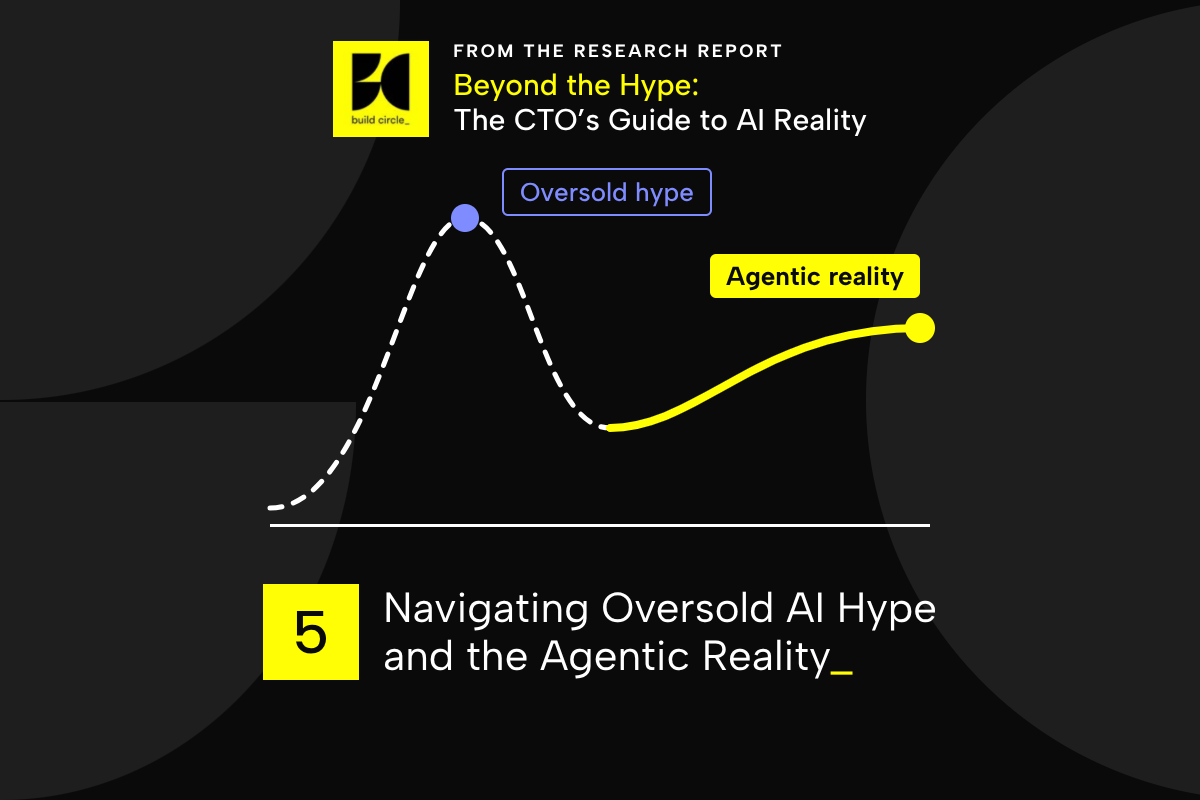
As the initial frenzy of Generative AI settles, enterprise technology is experiencing a necessary reality check. Boards initially viewed AI as an immediate fix to slash headcounts and eradicate overhead. In reality, successful adoption has proven to depend on people, cultural alignment, and disciplined systems architecture.
However, moving past the oversold marketing hype does not mean AI acceleration is slowing down. Enterprise software delivery is transitioning into its next permanent phase - autonomous agentic execution.
Spending on agentic AI capabilities is expanding at a 119% compound annual growth rate. Gartner predicts that 35% of traditional point-SaaS tools will be entirely eliminated by autonomous AI agents by 2030, placing $234 billion in enterprise software expenditure at risk.
Moving Beyond Prompts to Multi-Agent Operating Models
Traditional seat-based SaaS platforms rely on human beings sitting in front of graphical user interfaces, manually copying and pasting information between software silos. Autonomous agents bypass these user interfaces entirely.
Relying on simple prompt engineering in a browser window is insufficient for enterprise workflows. High-performing organisations are establishing API connection layers and Model Context Protocols (MCP) to deploy multi-agent systems. In this model:
- A central orchestrator holds high-level business workflow state.
- Specialised, lightweight agents execute specific tasks (e.g. database lookups, code refactoring, test execution, dependency scanning).
- Tasks are completed directly across backend platforms without manual human data entry.
The Fast-Follower Advantage
For technology leaders who avoided the early generative AI frenzy, the catch-up window has compressed dramatically.
Early experimenters in 2023 and 2024 bore the cost of brittle foundation models, bespoke middleware, and shifting API standards. Today, modern agentic frameworks build upon standardised foundation models and open protocols.
Organisations with clean data pipelines and modernised cloud infrastructure can bypass those early trial-and-error phases entirely. Research indicates that disciplined fast-followers can shorten requirements-to-deployment cycles by 35% to 50% within months of establishing clean architecture.
Tactical Steps for the Modern CTO
- Architect for Multi-Agent Workflows: Move past conversational chatbot interfaces. Build API integration layers and implement Model Context Protocols so agents can execute tasks directly across backend estates.
- Audit Point-SaaS Expenditures: Review your software inventory for point-SaaS applications that perform basic data transformation or aggregation. Begin reallocating seat-based subscription spend toward internal agentic workflows.
- Capitalise on Fast-Follower Velocity: Avoid building custom foundation models. Leverage standardised open models and proven engineering pods to accelerate delivery cycles safely and efficiently.
Read the complete research report, Beyond the Hype: The CTO's Guide to AI Reality, to benchmark your operating model and systems architecture.
Contact us_
Whether you’re modernising, migrating, scaling, or strengthening resilience, we’ll help you deliver faster, safer, and with stronger teams.
Let's talk about your roadmap.


