18.11.26
We have released a new research report, Beyond the Hype: The CTO's Guide to AI Reality.
Working closely with engineering leaders across banking, utilities, and scaling tech companies gives us a useful vantage point on what teams are experiencing on the ground. This post covers the fourth of five themes we have pulled together on the operational realities shaping engineering leadership right now.
The Legacy Handbrake: Why Modernisation is the Execution Layer of AI
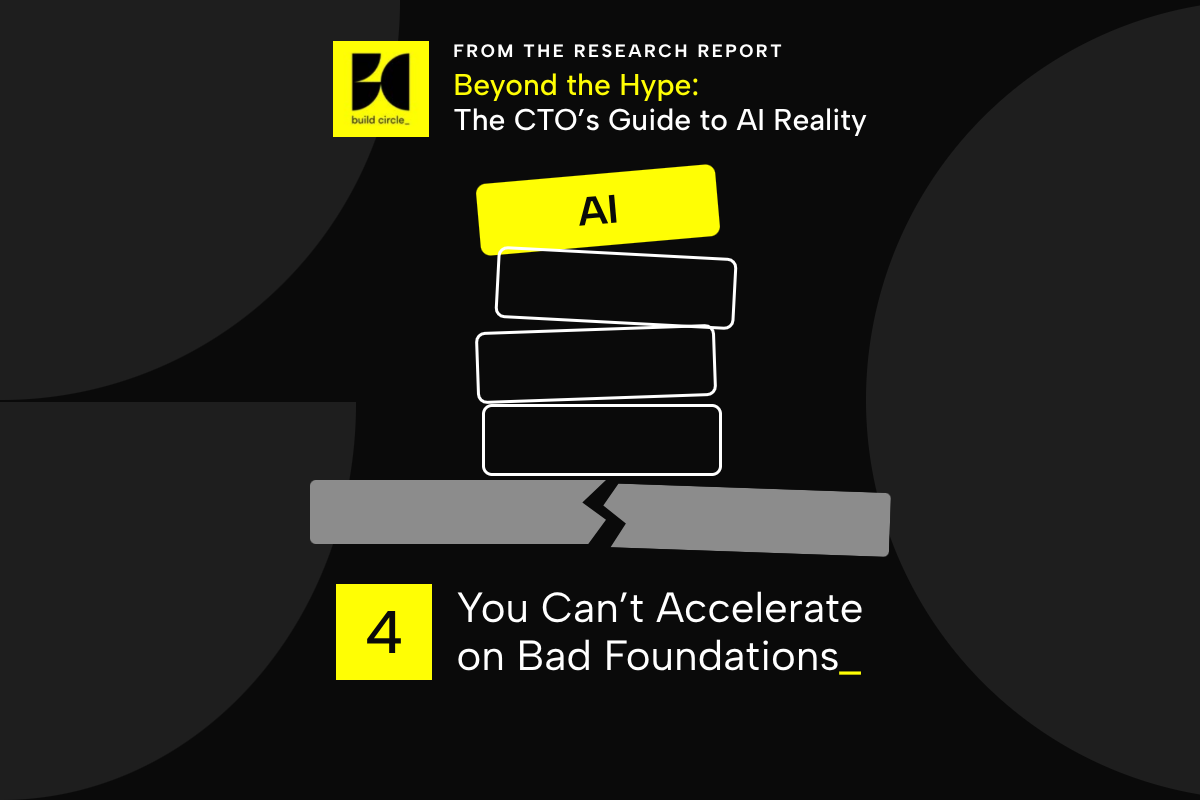
Deploying AI coding assistants onto fragile, tightly coupled architectures creates an illusion of speed that collapses the moment code hits production. To be an effective user of AI, an organisation must possess solid foundational engineering capabilities. Accelerating delivery processes with AI will only cause an enterprise to run into core system bottlenecks faster if the basics are not in place.
Deloitte benchmark data reveals that technical debt consumes between 21% and 40% of total IT budgets. With leaders reporting that this burden is actively increasing, engineering teams divert over 20% of project budgets simply to maintain legacy complexity rather than drive new delivery.
Layering generative tools over unmanaged technical debt creates a dangerous feedback loop. Security benchmarks show that approximately 45% of AI-generated code fails basic OWASP security checks. When developers generate code faster than their legacy pipelines can test, secure, and integrate, delivery grinds to a halt.
The Cloud Maturity Gap
Enterprise AI ambition is universal, but infrastructure readiness is not:
- 99% of organisations state that AI adoption accelerates their demand for cloud investments.
- 88% acknowledge that their current cloud maturity actively puts those AI initiatives at risk.
- Only 14% have achieved a fully "cloud-evolved" operational state capable of supporting production AI workloads.
Legacy applications and fragmented data platforms act as a direct tax on innovation. Research shows that 50% of IT leaders identify legacy platforms as the single greatest barrier to AI transformation.
Modernising the underlying tech stack liberates proprietary data, turning ongoing maintenance into a long-term commercial advantage. Off-the-shelf LLMs are accessible to every competitor. Your organisation’s unique, historical operational data is the asset that cannot be replicated - provided it is cleaned, structured, and accessible via secure modern pipelines.
Case Study: Modernising 400+ Enterprise Payment Workloads
A major UK retail payments provider supported critical settlement infrastructure across 400+ server applications. The estate was constrained by decades of technical debt, legacy message queues, and ageing codebases that created severe delivery bottlenecks.
Build Circle embedded a senior engineering pod to deploy a pragmatic "modernise where necessary, migrate where possible" refactoring engine. Senior engineers resolved core architectural bottlenecks and established migration guardrails, using AI tooling to accelerate routine code refactoring and automated test coverage.
The project delivered:
- Modernisation across 400+ application workloads without committing to a costly, high-risk multi-year rewrite.
- Rapid, continuous delivery at a fraction of standard transformation cost and risk.
- Systematic retirement of legacy software dependencies and infrastructure vulnerabilities.
- A repeatable migration path to transition critical payment workloads smoothly to cloud infrastructure.
Read Chapter 4 of Beyond the Hype: The CTO's Guide to AI Reality for the Modernisation Factory blueprint.
Contact us_
Whether you’re modernising, migrating, scaling, or strengthening resilience, we’ll help you deliver faster, safer, and with stronger teams.
Let's talk about your roadmap.


